



14 Aug 2026
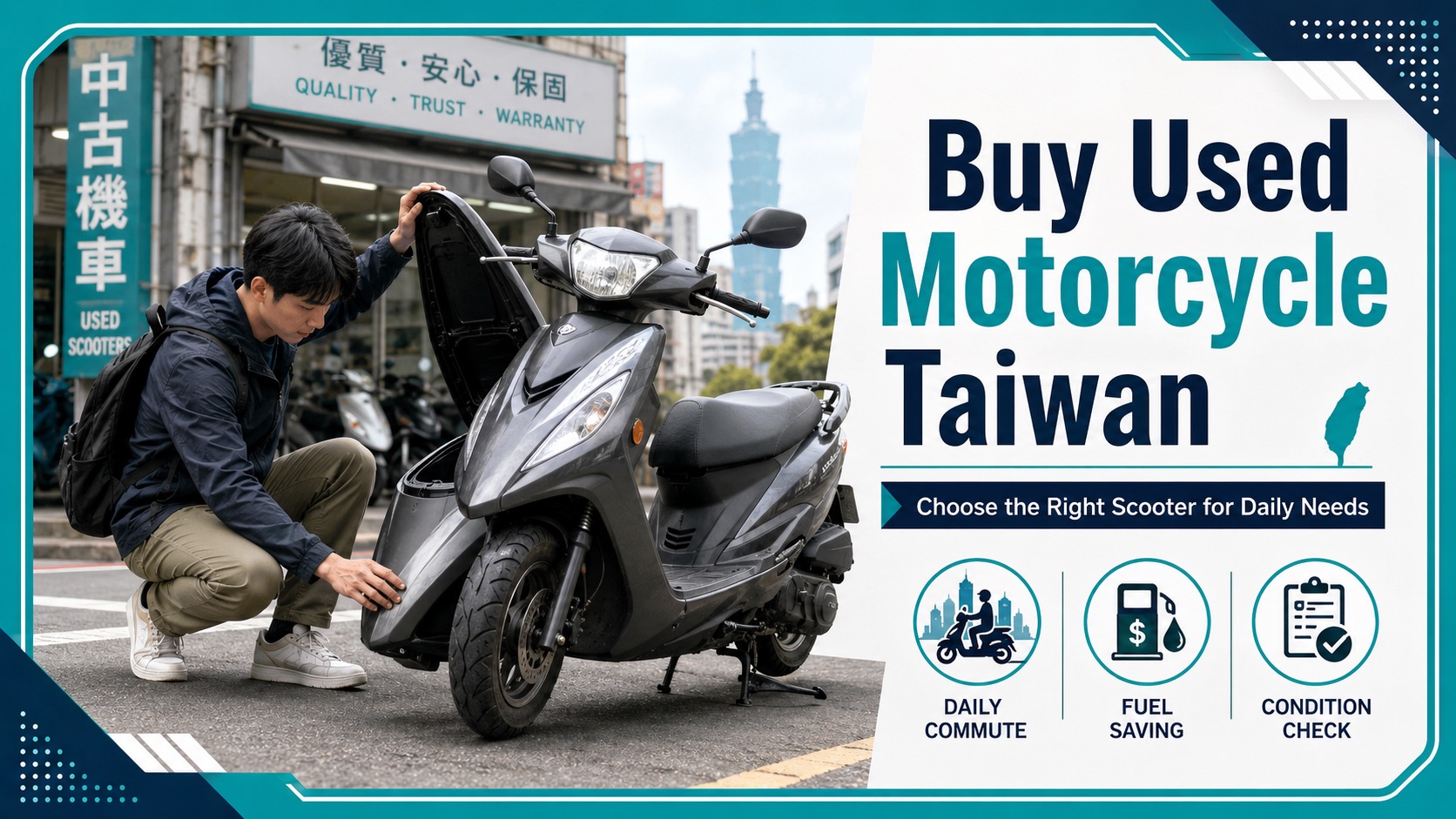
If you plan to buy used motorcycle Taiwan options, the first question should not be “Which one is the cheapest?” but “Which one fits my daily life?” In Taiwan, scooters and motorcycles are widely used for commuting, school, work, shopping, short trips, and city errands. A used motorcycle can be a practical and affordable choice, but only when it matches your riding distance, budget, maintenance expectations, and comfort level.
A second-hand scooter Taiwan purchase should be evaluated carefully. Engine condition, mileage, model year, documents, ownership transfer, repair history, and future maintenance costs all matter. A scooter that looks affordable at first may become expensive if it needs major repairs after purchase. This guide explains how to define your needs, inspect the scooter, understand pricing, check documents, compare dealer and private seller options, and make a safer buying decision.
Section One: Before Buying a Used Motorcycle, Define Your Needs
Do you need it for work or daily errands?
Before buying a used motorcycle, think about how you will actually use it. If you need it for work every day, reliability should be your top priority. A scooter for daily commuting should start easily, brake safely, ride smoothly, and be comfortable enough for repeated use.
If you only need it for errands, shopping, short trips, or occasional use, you may not need a powerful or newer model. A simple second-hand scooter that is easy to ride and maintain may already be enough. Defining your purpose helps you avoid paying for features you do not really need.
How far do you ride each day?
Daily riding distance affects what kind of scooter is suitable. If your commute is short and mostly within the city, a smaller scooter can be convenient, fuel-efficient, and easy to park. If you ride longer distances or often travel between districts, you may want a scooter with better stability and comfort.
Distance also affects maintenance. A scooter used for long daily rides will wear tires, brakes, oil, and other parts faster than one used occasionally. When comparing scooters, consider not only the purchase price but also how much it may cost to keep the scooter in good condition.
Should you choose 110cc, 125cc, or 150cc?
Common scooter sizes such as 110cc, 125cc, and 150cc each fit different needs. A 110cc scooter is usually lighter, easier to handle, and suitable for short city rides. A 125cc scooter is often a balanced choice for daily commuting, offering enough power while staying practical for city use. A 150cc scooter may feel stronger and more stable for longer routes, but it can also cost more to buy and maintain.
There is no single best size for everyone. The right choice depends on your route, riding confidence, parking environment, budget, and comfort. If you are a beginner or mainly ride short distances, smaller and easier-to-control models may be more practical. If you ride farther every day, stability and power may become more important.
Why your riding habits matter
Your riding habits matter because they determine what kind of scooter will feel comfortable over time. If you often ride during rush hour, a scooter that is easy to control in traffic may be better. If you carry bags or groceries, storage space becomes useful. If you park in a narrow area, scooter size and weight should be considered.
A used motorcycle should match your habits, not just your budget. A scooter that looks good but feels heavy, uncomfortable, or inconvenient may become annoying after a few weeks. Buying the right vehicle starts with understanding your own routine.
Section Two: Why Second-Hand Scooters Are Popular in Taiwan
Lower upfront cost than new motorcycles
Second-hand scooters are popular in Taiwan because they usually have a lower upfront cost than new motorcycles. For students, foreign workers, short-term residents, or people who want to control expenses, buying used can make transportation more affordable.
However, a lower purchase price should still be evaluated carefully. Buyers should prepare money not only for the scooter itself but also for oil change, tire checks, brake checks, battery condition, ownership transfer, and possible repairs. A used scooter is affordable only when the total cost remains manageable.
Many models are available in the market
Taiwan has a large scooter market, so buyers can usually find many used models, brands, engine sizes, and price ranges. This variety helps buyers compare different options and choose a scooter that fits their actual needs.
Having many choices is helpful, but it can also be confusing. A buyer may see scooters with similar prices but very different conditions. That is why comparing model year, mileage, engine condition, documents, and maintenance history is more useful than simply choosing the nicest-looking scooter.
Easier choice for short-term residents
For short-term residents, buying a second-hand scooter Taiwan option can be more practical than buying a new one. If you plan to stay in Taiwan for only a limited period, a used scooter may provide enough value without requiring a large investment.
Still, short-term use does not mean you should ignore condition and documents. A scooter with clear ownership information and stable performance will be easier to use and potentially easier to sell later. Even if you only need the scooter temporarily, it should still be safe and legally transferable.
Practical for city commuting and parking
Scooters are practical for city commuting in Taiwan because they are flexible, easy to park, and suitable for short to medium distances. In busy urban areas, a scooter can make daily travel more convenient than driving a car.
Used scooters are especially attractive for city users who care more about function than appearance. A scooter does not need to be new to be useful. If it is easy to ride, easy to park, and safe enough for daily travel, it can be a very practical transportation tool.
Section Three: How to Inspect a Second-Hand Scooter
Start with engine response and stability
The engine should be one of the first things you check. Start the scooter and listen carefully. A healthy engine should start smoothly, idle steadily, and avoid strange knocking sounds, heavy vibration, or unusual smoke. If the scooter is difficult to start or turns off easily, there may be mechanical or battery issues.
During inspection, do not rush. Let the scooter run for a short time and observe how stable it feels. If you are not experienced with scooters, bring a friend who understands motorcycles or choose a seller who can explain the condition clearly.
Check tires, brakes, lights, and suspension
Tires, brakes, lights, and suspension affect both safety and comfort. Check whether the tires are worn, whether the brakes respond properly, whether the headlight, brake light, and turn signals work, and whether the suspension feels normal. These basic parts are easy to overlook, but they matter every time you ride.
If several parts need replacement soon, include those costs in your budget. A scooter with a low price but worn tires, weak brakes, and bad lights may not be a good deal. Safety-related repairs should never be ignored just to save money.
Look for leaks, rust, or body damage
Look carefully for oil leaks, rust, cracks, broken panels, bent parts, or signs of previous accidents. Small scratches are normal on used scooters, but major damage may indicate rough use or past collisions. Body condition can also affect resale value.
Check under the scooter, around the engine area, near the exhaust, and along the body panels. A scooter does not need to be perfect, but the condition should be clear and reflected in the price. If the seller avoids discussing visible damage, be careful.
Ask about repair and maintenance history
Repair and maintenance history can help you understand how the scooter was cared for. Ask whether the oil was changed regularly, whether the tires or brakes were replaced, whether the battery is recent, and whether the scooter has had major engine repairs.
A scooter with a clear maintenance history is easier to evaluate. Even if it has been repaired before, that is not always a problem. The key is whether the repair was done properly and whether the seller explains it honestly.
Section Four: How to Understand Used Motorcycle Pricing
Model year changes the base price
Model year is one of the main factors that affects used motorcycle pricing. Newer scooters usually cost more because they have been used for a shorter time and may have better features. Older scooters are usually cheaper, but they may need more careful inspection.
Still, model year should not be viewed alone. A well-maintained older scooter can be more reliable than a newer scooter that was poorly maintained. Buyers should compare model year together with mileage, engine condition, repair history, and documents.
Mileage affects long-term value
Mileage affects long-term value because it shows how much the scooter has been used. Lower mileage is often more attractive, but it does not guarantee better condition. A low-mileage scooter that has been left unused for a long time may still need maintenance.
Higher mileage is not automatically bad if the scooter has been maintained properly. The important question is whether the mileage matches the condition. If a scooter has high mileage but runs smoothly and has clear maintenance records, it may still be worth considering.
Brand popularity influences resale potential
Brand popularity can influence resale potential. Common scooter brands and models are often easier to repair, easier to find parts for, and easier to resell later. Buyers may feel more comfortable choosing models they recognize.
Less common models may be cheaper, but they can be harder to maintain or resell. If you plan to use the scooter for only a short time and sell it later, resale potential should be part of your decision. A popular model may cost more at first but hold value better.
Repair costs should be part of the budget
Repair costs should always be part of your budget. After buying a used scooter, you may need to change oil, replace tires, check brakes, replace a battery, repair lights, or handle other maintenance. These costs can change the real total price.
A scooter that is cheaper at purchase may become more expensive if it needs several repairs. Before making a decision, estimate what needs to be fixed soon. The best value is not always the lowest price; it is the scooter with the best balance between price, condition, and future cost.
| Pricing Factor | What It Means | How It Affects Your Decision |
|---|---|---|
| Model year | How old the scooter is | Newer models often cost more |
| Mileage | How much the scooter has been used | Lower mileage may increase value |
| Engine condition | Stability, sound, and starting response | Poor engine condition can raise repair costs |
| Brand popularity | Market demand and parts availability | Popular models may be easier to resell |
| Body condition | Scratches, rust, or accident signs | Damage should be reflected in the price |
| Repair cost | Maintenance needed after purchase | Changes the real total budget |
Section Five: Documents and Ownership Transfer
Check vehicle registration information
Before buying a used motorcycle in Taiwan, check the vehicle registration information carefully. Make sure the scooter details match the documents, including plate number, model, engine information, and ownership details where applicable. Clear registration information helps reduce transaction risk.
If something does not match or the seller cannot explain the documents clearly, do not rush to pay. Vehicle documents are just as important as engine condition. A scooter that runs well but has unclear ownership information can still create problems.
Confirm whether transfer support is available
Ownership transfer is an important part of buying a used scooter. Buyers should ask whether the seller provides transfer support and what steps are involved. This is especially important for foreign buyers who may not be familiar with local procedures.
A seller who can explain the transfer process clearly makes the purchase easier and safer. If the process is confusing or no one can explain what happens after payment, buyers should be cautious. A clear transfer process helps protect both sides.
Ask what documents are required
Ask what documents are required before the transaction. Depending on the situation, buyers may need identification, registration-related information, payment records, and other documents required for the transfer process. Requirements should be confirmed before making the final decision.
Understanding document requirements early helps prevent delays. It also shows whether the seller is organized and experienced. A reliable seller should be able to guide buyers through the basic document process.
Keep transaction records after purchase
After buying a scooter, keep all transaction records. This can include receipts, payment proof, messages, photos, transfer documents, and any written agreement. These records may be useful if questions come up later.
Keeping records is a simple habit, but it protects buyers. Do not rely only on memory. A clear purchase record makes ownership and future resale easier to manage.
Section Six: Buying from a Dealer Versus Private Seller
Dealers may offer clearer information
Buying from a dealer may provide clearer information because dealers often handle multiple scooters and have a more structured sales process. They may be able to explain model year, mileage, price, repair history, ownership transfer, and condition details more consistently.
A dealer may also offer a wider selection, making comparison easier. This does not mean every dealer is automatically reliable, but a transparent dealer can reduce confusion for buyers who want a more guided buying process.
Private deals may require more checking
Private sellers may sometimes offer lower prices, but private deals usually require more careful checking. Buyers may need to inspect the scooter more thoroughly, confirm documents, ask detailed questions, and understand the transfer process by themselves.
A private deal can still be a good option if the scooter is in good condition and the seller is honest. However, buyers should not skip inspection just because the price looks attractive. Without enough information, the risk can be higher.
After-sale questions are easier with support
After-sale questions are often easier when some support is available. Buyers may have questions about maintenance, documents, transfer, or basic scooter use after purchase. A seller or dealer who provides clear support can make the experience smoother.
Private sellers may be harder to contact after the transaction, depending on the situation. This is why buyers should consider not only the price, but also the level of communication and support available before and after payment.
Transparency is more important than speed
Whether buying from a dealer or private seller, transparency is more important than speed. A fast transaction is not always a good transaction. Buyers should take time to understand the scooter condition, price, documents, and transfer process.
If a seller pressures you to pay quickly without allowing questions or inspection, slow down. A good purchase should feel clear, not rushed. When information is transparent, the buying decision becomes much safer.
Section Seven: How to Make a Better Buying Decision
Compare at least several similar models
Before deciding, compare at least several similar models. Look at scooters with similar engine size, model year, mileage, condition, and price. This helps you understand the market and avoid overpaying for a scooter.
Comparison also helps you identify which scooter offers better value. A slightly higher-priced scooter with better condition may be a smarter purchase than the cheapest scooter available. Do not decide based on one listing alone.
Balance price, condition, and future use
A better buying decision balances price, condition, and future use. Ask yourself whether the scooter fits your daily route, whether the condition is acceptable, whether repair costs are manageable, and whether the documents are clear. These points matter more than price alone.
A used scooter is a practical tool. It should make your daily life easier, not create more stress. The right scooter is one that you can afford, maintain, and use safely.
Do not rush because of limited stock
Limited stock can create pressure, but rushing can lead to mistakes. Some buyers pay quickly because they fear losing a good deal, only to discover later that the scooter needs expensive repairs or has unclear documents.
If the scooter is truly suitable, clear information should support the decision. If important details are missing, take more time. There will usually be other scooters available. It is better to miss one deal than to buy the wrong vehicle.
Choose a process you can understand clearly
Finally, choose a buying process you can understand clearly. The seller should explain how to inspect the scooter, how pricing works, what documents are needed, how ownership transfer is handled, and what happens after payment. A clear process reduces confusion and unnecessary risk.
For first-time buyers and foreign residents in Taiwan, this is especially important. Buying a second-hand scooter Taiwan option should not feel like guessing. The clearer the process, the more confident the decision.
Conclusion
When you buy used motorcycle Taiwan options, the best choice is not always the cheapest one. A second-hand scooter should be selected based on your daily riding needs, engine condition, mileage, model year, documents, price transparency, ownership transfer process, and future maintenance cost. A scooter that fits your routine and budget will usually be more valuable than one that only looks cheap at first.
Buyers should compare different models, check the condition in person if possible, ask enough questions, and confirm the ownership transfer process before making a final decision. A clear and transparent buying process makes the experience more practical and reduces unnecessary risk. With the right preparation, buying a used motorcycle in Taiwan can be affordable, safe, and suitable for daily transportation.
FAQ
Q:How do I buy a used motorcycle in Taiwan?
Start by defining your daily riding needs and budget. Then compare similar models, inspect the engine, tires, brakes, lights, body condition, mileage, documents, and ownership transfer process before payment.
Q:What is the difference between a used motorcycle and a second-hand scooter?
In everyday use, many people use both terms to refer to pre-owned two-wheel vehicles. A second-hand scooter usually refers to a smaller automatic scooter used for commuting, while used motorcycle can be a broader term covering different engine sizes and vehicle types.
Q:Which scooter size is suitable for daily commuting?
For short city rides, 110cc may be enough. For balanced daily commuting, 125cc is often practical. For longer rides or stronger performance, 150cc may be more comfortable. The best size depends on your route, comfort, and budget.
Q:What documents should I check before buying?
Check vehicle registration information, ownership-related details, transfer requirements, and any transaction records. Make sure the scooter details match the documents before making payment.
Q:Should I buy from a dealer or a private seller?
Both can work, but they require different levels of checking. Dealers may offer clearer information and transfer support, while private sellers may offer lower prices but require more careful inspection. Transparency is more important than speed or price alone.
Related Articles
- How to Buy a Used Scooter in Taiwan? A Practical Guide to Affordable Choices and Safer Buying
- Affordable Motorcycle Taiwan: How to Find the Right Motorbike Distributor for Better Value
- Used Scooter Wholesale Taiwan: How to Choose a Reliable Used Motorcycle Supplier
- Second-Hand Scooter Dealer Taiwan: Bulk Used Motorbike Buying Guide for Resellers