



14 Aug 2026
Running a second-hand scooter dealer Taiwan business is very different from buying one scooter for personal use. A dealer needs to think about supply, inventory quality, customer demand, repair costs, resale speed, documents, and long-term supplier relationships. In the used scooter market, profit does not come only from buying at a low price. It also comes from choosing the right stock, reducing unexpected costs, and building trust with buyers.
For resellers, shops, fleet operators, and export buyers, bulk used motorbike Taiwan purchasing can create good business opportunities. However, bulk buying also increases risk because each unit may have a different model year, mileage, engine condition, body condition, repair need, and resale potential. A good bulk purchase should support stable inventory, predictable margins, and clear communication with both suppliers and customers.
Section One: What Does a Second-Hand Scooter Dealer Do?
Dealers connect scooter supply and buyers
A second-hand scooter dealer connects scooter supply with buyers who need reliable used vehicles. Supply may come from distributors, individual owners, auctions, fleet returns, repair shops, or other wholesale sources. Buyers may include personal users, resellers, shops, exporters, or businesses needing multiple units.
The dealer’s role is not only to move scooters from one side to another. A good dealer filters stock, checks basic condition, explains scooter details, manages pricing, handles buyer questions, and helps create a smoother transaction. In a market where used vehicle condition can vary a lot, the dealer’s ability to organize information becomes very valuable.
Dealer needs differ from personal buyers
A personal buyer usually focuses on one scooter that fits daily commuting, budget, and comfort. A dealer has to think differently. Dealers need to evaluate whether a scooter can be resold, whether the model has market demand, whether repair costs are manageable, and whether the unit can fit their target customer group.
This means dealers should not choose stock only based on personal preference. A scooter may look attractive, but if customers rarely ask for that model, it may stay in inventory too long. Dealer buying decisions should be based on demand, cost, condition, and resale strategy.
Why stock quality affects reputation
Stock quality directly affects dealer reputation. If customers buy scooters that match the dealer’s description and perform reliably, they are more likely to trust the dealer again. If scooters have unexpected problems or condition details were not explained clearly, customer confidence can drop quickly.
In the used scooter business, reputation is a long-term asset. A dealer may earn short-term profit from one unclear sale, but that can damage future business. Clear condition information, fair pricing, and honest communication help protect the dealer’s name.
How bulk buying changes decision-making
Bulk buying changes decision-making because the dealer is not evaluating just one scooter. A bulk purchase may include different models, model years, mileage levels, and condition groups. Some units may be ready for resale, while others may need cleaning, repair, or deeper inspection.
Dealers must calculate the overall value of the whole batch. A few good scooters do not automatically make the entire purchase profitable. The dealer needs to understand the mix of units, likely repair costs, resale prices, and how quickly each type of scooter can move.
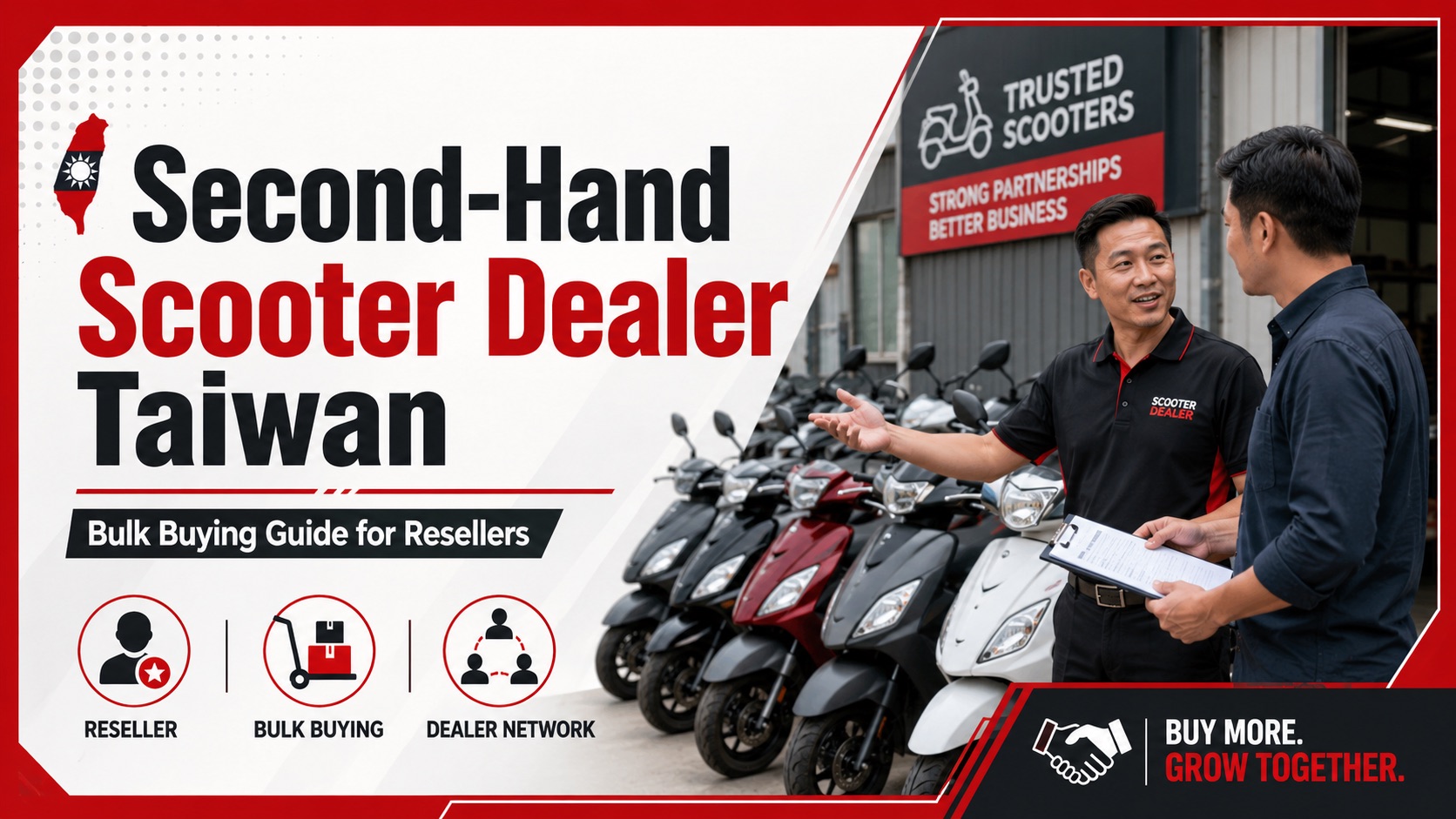
Section Two: Who Needs Bulk Used Motorbikes in Taiwan?
Resellers building regular inventory
Resellers need bulk used motorbikes to build regular inventory. Instead of searching for one scooter at a time, bulk buying allows resellers to prepare several options for different customer needs. This can help them sell more consistently and respond faster when customers ask for available models.
For resellers, the key is not only buying cheap stock. They need scooters that can be sold within a reasonable time. Models with stable demand, clear condition, and manageable repair costs are usually better than very cheap units that sit unsold for months.
Shops expanding model selection
Used scooter shops may use bulk buying to expand model selection. Customers often want to compare different price ranges, engine sizes, model years, and body conditions before deciding. If a shop has only a few options, it may lose buyers who are still comparing.
Bulk used motorbike Taiwan purchasing can help shops offer more choices. For example, a shop may keep lower-priced scooters for budget buyers, cleaner units for buyers who want ready-to-ride options, and popular models for daily commuters. Better selection can improve customer confidence and increase sales opportunities.
Businesses needing fleet replacement
Some businesses need multiple scooters for operations, such as delivery, field service, staff transportation, or short-distance work use. For these buyers, bulk used motorbikes can reduce upfront costs compared with buying new units.
Business buyers usually care about stability, maintenance convenience, and total operating cost. They may not need the newest models, but they do need scooters that can be used reliably. Dealers serving business customers should understand these needs and prepare stock accordingly.
Export buyers looking for consistent supply
Export buyers may need consistent used scooter supply for overseas markets. They usually care about quantity, model mix, condition categories, documents, and preparation costs. For export buyers, consistency is often more important than finding one or two extremely cheap units.
A dealer who can provide organized stock information and stable supply is more attractive to export buyers. Clear lists, condition notes, model details, and responsive communication make it easier for export buyers to plan purchasing and logistics.
Section Three: How Dealers Should Select Bulk Stock
Choose models with proven demand
Dealers should choose models with proven market demand. Scooters that are easy to ride, fuel-efficient, easy to maintain, and familiar to buyers usually sell faster. Popular models may not always offer the highest margin per unit, but they often support better stock turnover.
Demand should be checked through past sales, customer inquiries, market listings, and local buyer habits. A model that sells well for one dealer may not sell as well for another if their customer base is different. Dealers need to know their own market, not just follow what looks popular elsewhere.
Check condition groups before purchase
Before buying in bulk, dealers should check condition groups. A batch may include ready-to-sell units, units needing minor service, units needing body repair, and units with mechanical concerns. Each group should be valued differently.
Condition grouping helps dealers calculate more accurately. If most units need preparation, the purchase price must allow enough room for repair and resale margin. If most units are clean and ready, a higher purchase price may still make sense. The key is knowing the mix before committing.
Avoid units with unclear repair costs
Units with unclear repair costs can create serious margin problems. A scooter may look cheap, but if the engine, brakes, suspension, battery, or body condition is unknown, the dealer cannot calculate profit properly. Unknown repair costs are one of the biggest risks in bulk buying.
This does not mean dealers should avoid every repair-needed scooter. Some units can be profitable if repair needs are clear and pricing reflects the work required. The real danger is buying stock without enough condition information. Cheap surprises are still surprises, and repair shops do not accept “but it looked like a good deal” as payment.
Balance purchase price and resale speed
A good dealer should balance purchase price and resale speed. A low unit price may seem attractive, but if the scooter is difficult to sell, capital stays locked in inventory. A slightly higher-priced unit that sells quickly may generate better business results.
Resale speed affects cash flow, storage space, and future purchasing ability. Dealers should think in terms of inventory movement, not only unit margin. A fast-moving scooter can sometimes be more valuable than a high-margin scooter that waits too long for the right buyer.
Section Four: How to Calculate Bulk Buying Value
Unit price is only the starting point
Unit price is only the starting point in bulk buying. Dealers must add repair costs, cleaning, inspection, storage, transportation, document handling, transfer-related work, and selling expenses. The real cost of each scooter is higher than the purchase number on the supplier quote.
To calculate value properly, dealers should estimate average cost per unit after preparation. This helps determine whether the resale price can still support profit. Without full cost calculation, a bulk deal may look profitable on paper but become weak in practice.
Repair and preparation costs matter
Repair and preparation costs can strongly affect profit. Even small items such as oil changes, tires, brakes, batteries, lights, panels, and cleaning can add up when multiplied across many units. Dealers should not underestimate these costs.
A scooter that needs light preparation may still be very profitable. A scooter that needs major work may only make sense if the purchase price is low enough. Dealers should create a basic repair-cost checklist before accepting a bulk offer.
Storage time affects final profit
Storage time affects final profit because unsold inventory uses space and holds capital. The longer a scooter stays unsold, the more pressure it creates. It may also need additional cleaning, battery maintenance, price adjustment, or promotional effort.
Dealers should consider how quickly each model is likely to sell. Fast-moving inventory supports healthier business. Slow-moving stock may still be acceptable if the margin is high enough, but it should be planned intentionally, not discovered accidentally.
Market demand determines resale opportunity
Market demand determines whether a scooter can be resold at the expected price. A popular daily commuting model may have stronger resale opportunity, while a less common model may require more time and explanation. Dealers should always connect stock selection with buyer demand.
Market demand can change over time. Dealers should monitor which models customers ask about, which price ranges move faster, and which units receive fewer inquiries. This information helps improve future bulk buying decisions.
| Bulk Value Factor | What Dealers Should Calculate | Why It Matters |
|---|---|---|
| Unit price | Supplier price per scooter | Starting point for margin |
| Repair cost | Tires, brakes, battery, engine, body work | Can reduce profit quickly |
| Preparation cost | Cleaning, inspection, basic service | Affects ready-to-sell condition |
| Storage time | How long the unit may stay in inventory | Impacts cash flow and space |
| Resale demand | How easily the model can sell | Determines turnover speed |
| Document process | Transfer and paperwork handling | Reduces transaction risk |
Section Five: How to Compare Supplier Offers
Compare condition, not just total price
When comparing supplier offers, dealers should compare condition, not just total price. A cheaper batch may include more repair-needed units, while a higher-priced batch may include scooters that are easier to sell. The total price alone does not explain the real value.
Ask for condition details, photos, videos, mileage, model year, document status, and repair notes. The better the information, the more accurate the comparison. Dealers should avoid judging offers only by the average unit price.
Ask about quantity and model mix
Quantity and model mix should be reviewed carefully. A batch of ten scooters can be very different depending on the models included. If most units are popular daily-use scooters, the batch may be easier to resell. If the batch contains many low-demand models, it may be harder to move.
Dealers should ask whether the supplier can adjust the model mix based on target buyers. A flexible supplier can help dealers build more suitable inventory. The best bulk stock is not just large in quantity; it is aligned with demand.
Confirm transfer and document support
Transfer and document support should be confirmed before purchase. Dealers need to know what documents come with each unit, whether ownership transfer support is available, and how the paperwork process is handled. Unclear documents can delay resale and create unnecessary risk.
A reliable supplier should explain the document process clearly. For bulk purchases, document consistency is especially important. One problematic unit can slow down a whole batch if the process is not organized.
Evaluate response speed and clarity
Response speed and clarity matter when working with suppliers. Dealers often need quick answers about availability, pricing, condition, quantity, and documents. Slow or unclear communication can delay decisions and cause missed sales opportunities.
However, fast replies must also be accurate. A supplier who answers quickly but vaguely is still difficult to work with. Good suppliers provide useful information in a timely and consistent way.
Section Six: Mistakes Dealers Should Avoid
Buying too many low-demand models
One common mistake is buying too many low-demand models. These scooters may look attractive because the price is low, but they can stay in inventory for too long. Slow-moving stock reduces cash flow and makes it harder to buy better inventory later.
Dealers should study customer demand before buying. If a model rarely receives inquiries, it should only be purchased when the price and strategy make sense. Buying low-demand stock without a plan is not a bargain; it is a storage problem with wheels.
Ignoring inspection before bulk purchase
Ignoring inspection before bulk purchase can lead to costly mistakes. Even if the supplier is familiar, dealers should still request condition information or inspect the units when possible. Bulk buying increases risk because small problems multiply across many scooters.
Inspection does not always require a full mechanical report, but there should be enough information to estimate repair needs. Engine response, tires, brakes, body condition, mileage, and documents should all be checked or clearly described.
Underestimating repair and cleaning costs
Repair and cleaning costs are easy to underestimate. A scooter may need only minor work, but when this happens across many units, the total cost becomes meaningful. Cleaning, detailing, oil changes, batteries, tires, and brake adjustments can all affect final profit.
Dealers should create a standard preparation budget for each condition group. This helps prevent overpaying for stock and makes resale pricing more accurate. Clean, ready-looking scooters are easier to sell, but getting them ready is not free.
Choosing one-time low prices over stable supply
Another mistake is choosing one-time low prices over stable supply. A very cheap batch may bring short-term profit, but if the supplier cannot provide consistent quality or communication, long-term business may suffer. Stable supply allows better planning, pricing, and customer service.
Dealers should not ignore good deals, but they should also value supplier reliability. A dependable supplier with fair pricing may be more valuable than a random low-price offer that cannot be repeated.
Section Seven: How to Build a Sustainable Dealer Strategy
Track which models sell faster
Dealers should track which models sell faster. Record model type, purchase price, preparation cost, selling price, selling time, and buyer feedback. Over time, this data will show which scooters are best for the dealer’s market.
Without tracking, dealers may rely too much on memory or guesswork. Data helps dealers avoid repeating mistakes and focus on models with better turnover. A sustainable dealer strategy starts with knowing what actually sells.
Build relationships with stable suppliers
Stable supplier relationships are essential for long-term growth. A good supplier can provide consistent stock updates, clear condition details, fair pricing, and smoother transaction support. This helps dealers plan inventory more confidently.
Building supplier relationships also improves communication. When suppliers understand a dealer’s target market, they can recommend more suitable stock. Long-term cooperation often creates better efficiency than constantly searching for new sources.
Keep inventory matched to customer needs
Inventory should match customer needs. If customers are mainly commuters, stock should focus on practical, reliable, easy-to-maintain scooters. If customers are businesses, fleet-friendly models and consistent conditions may matter more. If customers are budget buyers, affordable but clear-condition units may be best.
A dealer’s inventory should reflect real demand, not random availability. Stock that matches customers sells faster, creates fewer complaints, and supports better reputation. The goal is not to have many scooters; the goal is to have the right scooters.
Use transparent information to build trust
Transparent information builds trust with buyers. Dealers should explain model year, mileage, engine condition, body condition, repair history, documents, and price reasoning clearly. Buyers are more likely to trust a dealer who explains both strengths and limitations.
Trust helps create repeat business and referrals. In the used scooter market, customers understand that vehicles are not always perfect. What they need is honesty. A dealer who communicates clearly can turn transparency into a competitive advantage.
Conclusion
For a second-hand scooter dealer Taiwan market strategy, bulk purchasing should focus on stock quality, resale potential, repair costs, supplier reliability, document handling, and customer demand. A good bulk deal is not simply the lowest unit price. It must also support stable inventory, predictable margins, and long-term buyer trust.
In bulk used motorbike Taiwan purchasing, dealers who compare supplier offers carefully, calculate total cost, track stock movement, and maintain transparent communication can build a stronger business. The used scooter market has plenty of opportunity, but sustainable growth comes from organized inventory decisions, reliable suppliers, and a buying process that customers can trust.
FAQ
Q: What does a second-hand scooter dealer in Taiwan do?
A second-hand scooter dealer in Taiwan connects scooter supply with buyers, including personal users, resellers, shops, businesses, and export buyers. Dealers select stock, explain condition, manage pricing, and support transactions.
Q: Who should buy bulk used motorbikes?
Bulk used motorbikes are suitable for resellers, used scooter shops, businesses needing fleet replacement, export buyers, and dealers who want regular inventory. Bulk buying works best for buyers who can manage stock, repair costs, and resale planning.
Q: How do dealers choose used scooter inventory?
Dealers should choose inventory based on market demand, condition groups, repair costs, resale speed, model popularity, and target customer needs. The best stock is not always the cheapest; it is the stock that can sell profitably.
Q: What costs should be included in bulk buying?
Dealers should include unit price, repair cost, cleaning, inspection, storage, transportation, document handling, transfer-related work, and selling expenses. These costs determine the real margin of each scooter.
Q: How can dealers find reliable used scooter suppliers?
Dealers should compare suppliers based on condition transparency, model mix, quantity options, document support, communication clarity, pricing rules, and supply stability. A reliable supplier should support repeat cooperation, not just one-time low prices.
Related Articles
- How to Buy a Used Scooter in Taiwan? A Practical Guide to Affordable Choices and Safer Buying
- Buy Used Motorcycle Taiwan: How to Choose a Second-Hand Scooter That Fits Your Daily Needs
- Affordable Motorcycle Taiwan: How to Find the Right Motorbike Distributor for Better Value
- Used Scooter Wholesale Taiwan: How to Choose a Reliable Used Motorcycle Supplier