



14 Aug 2026
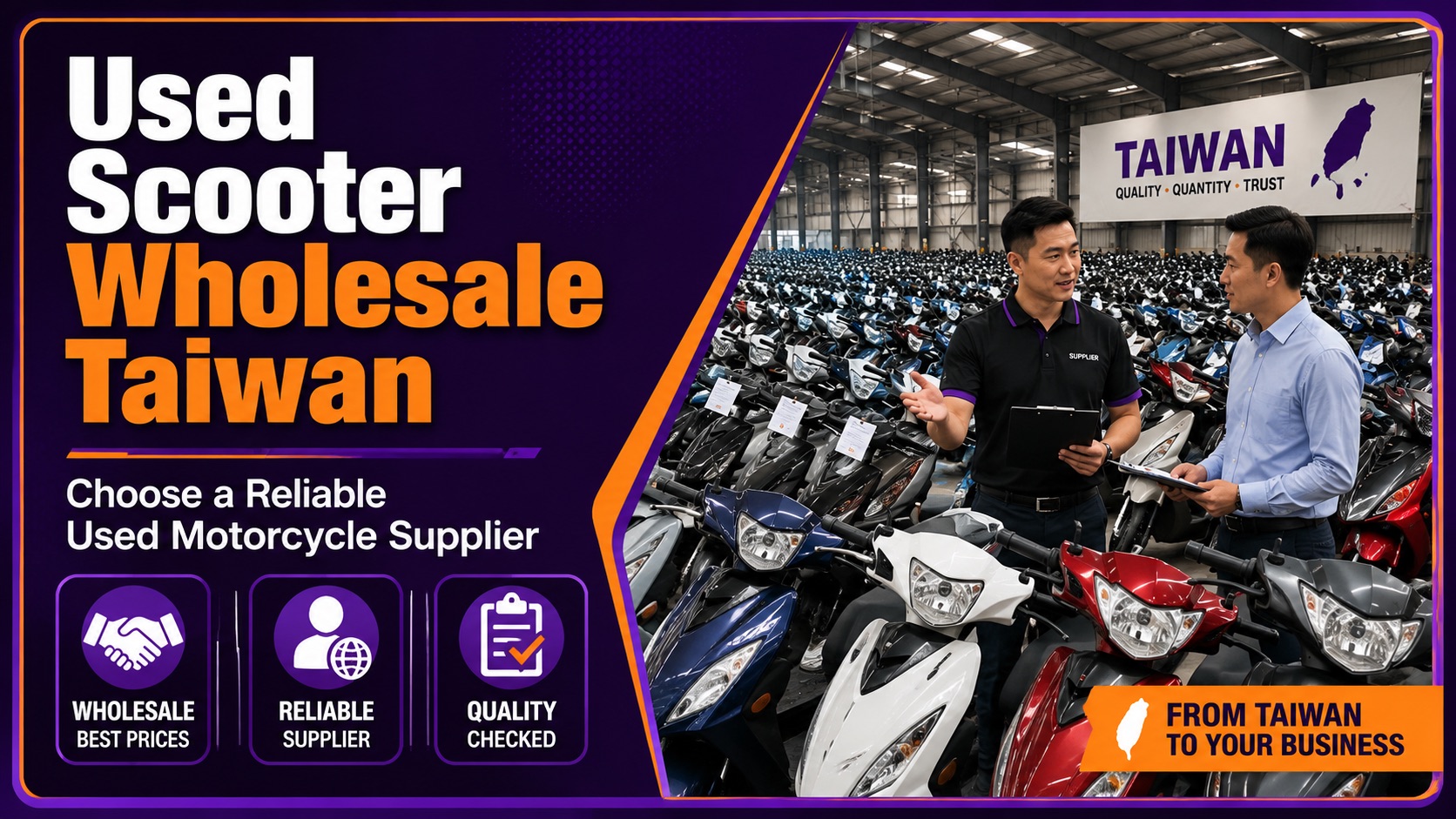
For dealers, resellers, exporters, and businesses that need multiple scooter units, used scooter wholesale Taiwan can be a practical way to secure inventory at more competitive prices. Instead of buying one scooter at a time, wholesale buyers often look for multiple units, consistent supply, and pricing that leaves enough room for resale, repair, shipping, or business operation costs. This makes supplier selection one of the most important parts of the process.
However, choosing a used motorcycle supplier Taiwan option should not be based only on unit price. In wholesale buying, every scooter may have a different model year, mileage, engine condition, body condition, document status, and repair requirement. If these details are unclear, the buyer may face unexpected costs after purchase. This guide explains how wholesale buying works, why supplier reliability matters, how to evaluate a supplier, what affects wholesale pricing, and how to build long-term cooperation with lower risk.
Section One: What Is Used Scooter Wholesale in Taiwan?
Wholesale buying is different from retail buying
Wholesale buying is different from retail buying because the buyer is usually purchasing multiple units instead of one scooter for personal use. A retail buyer may focus on one scooter that fits daily commuting needs. A wholesale buyer must evaluate a group of scooters and consider resale potential, repair cost, stock movement, and overall profit margin.
This means the decision process is more complex. Wholesale buyers need to think beyond “Is this scooter good for me?” They need to ask whether the inventory can be resold, whether the condition is clear, whether the pricing is realistic, and whether the supplier can support repeated purchases.
Who needs used scooters in bulk?
Used scooters in bulk may be needed by used motorcycle dealers, resellers, export businesses, rental operators, delivery-related businesses, repair shops, or companies that need several scooters for daily operations. Each buyer type may have different requirements. Some want low-cost units for resale, while others need scooters with stable condition for business use.
For example, a reseller may prioritize models that are easy to sell quickly. A business operator may prioritize durability and maintenance convenience. An exporter may care more about batch condition, documentation, model category, and quantity availability. Because needs vary, wholesale inventory should be selected strategically.
Why bulk pricing can be more competitive
Bulk pricing can be more competitive because the buyer is taking multiple units at once. This can allow the supplier to offer better unit pricing compared with retail sales. For resellers and dealers, better unit pricing creates room for repair, handling, storage, and resale margin.
However, a lower unit price does not automatically mean a better deal. Buyers must check whether the lower price comes with higher repair needs, older model years, mixed unit conditions, or slower resale potential. In wholesale buying, the real cost is not just the unit price; it is the cost of getting each scooter ready for its next purpose.
What buyers should prepare before inquiry
Before contacting a used motorcycle supplier, buyers should prepare their target quantity, preferred model types, budget range, target customer group, expected condition level, and resale or operational plan. Clear preparation helps the supplier provide more relevant options.
Wholesale buyers should also prepare questions about condition grading, pricing rules, transfer process, document handling, pickup or shipping, and payment terms. The more specific the inquiry, the easier it is to evaluate whether the supplier is suitable. A vague inquiry often leads to vague inventory recommendations, and that is where confusion begins.
Section Two: Why Supplier Reliability Matters
Unit condition may vary in bulk purchases
In wholesale purchases, unit condition can vary from one scooter to another. Some units may be ready for resale, some may need basic maintenance, and some may require more repairs. This is normal in the used scooter market, but it must be clearly communicated before purchase.
A reliable supplier should help buyers understand these differences. If all scooters are described as “good” without details, buyers may not be able to calculate repair costs or resale value accurately. In wholesale buying, condition variation is not the problem; unclear condition information is the real risk.
Clear information helps reduce risk
Clear information helps reduce wholesale buying risk. Buyers need details such as model year, mileage, engine condition, body condition, tire and brake status, document condition, and repair notes. These details allow buyers to estimate total cost and resale potential.
A supplier who provides clear unit information gives buyers more control over their decisions. Even if some scooters need repairs, buyers can still evaluate whether the pricing makes sense. Transparency allows buyers to plan, while unclear information forces them to guess. Guessing is not a very strong business model, even if the price looks exciting.
Stable supply supports business planning
Stable supply is important for dealers, resellers, and businesses that need regular inventory. If a supplier can provide scooters consistently, buyers can plan sales, marketing, storage, repair schedules, and customer offers more efficiently. This is especially important for buyers who operate continuously.
Unstable supply can make business planning difficult. If inventory is available only randomly or changes too much from batch to batch, buyers may struggle to meet customer demand. A reliable supplier helps buyers maintain business rhythm instead of starting from zero every time they need stock.
Responsive communication improves efficiency
Responsive communication improves efficiency because wholesale transactions often involve many details. Buyers may need to ask about quantity, model mix, pricing, documents, condition categories, delivery timing, and payment. If communication is slow or unclear, the process becomes harder to manage.
A good used motorcycle supplier Taiwan option should answer questions clearly and consistently. Fast communication alone is not enough; the answers must also be useful. Wholesale buyers need information that supports decisions, not short replies that create more questions.
Section Three: How to Evaluate a Used Motorcycle Supplier
Check whether unit details are complete
The first step in evaluating a supplier is checking whether unit details are complete. Important details include brand, model, engine size, model year, mileage, engine condition, body condition, visible damage, document status, and any known repair needs. For bulk orders, buyers may also need a list or summary by category.
Complete information helps buyers compare units and estimate resale value. If a supplier cannot provide basic details, the buyer will have difficulty understanding the true value of the stock. In wholesale business, missing information can turn into missing profit.
Ask how scooter condition is categorized
Buyers should ask how the supplier categorizes scooter condition. For example, are scooters separated into ready-to-sell units, units needing minor service, units requiring repair, and lower-cost units for specific buyers? Clear categorization helps buyers choose the right inventory for their business model.
Condition categories also help with pricing. A batch with mostly ready-to-sell scooters should not be priced the same as a batch with many repair-needed units. Buyers should understand the condition mix before making a decision.
Confirm pricing and quantity options
Pricing and quantity options should be confirmed clearly. Buyers should ask whether pricing is based on individual units, mixed batches, minimum order quantity, model category, or purchase volume. They should also ask whether there are additional costs related to documents, transfer, transport, or handling.
Clear pricing makes profit calculation easier. If buyers only know the unit price but not the additional costs, the final margin may be different from expected. A reliable supplier should explain pricing rules in a way buyers can understand before payment.
Understand the purchase and transfer process
Wholesale buyers should understand the full purchase and transfer process. This includes how scooters are selected, how condition is confirmed, how payment is made, how documents are handled, whether ownership transfer support is available, and how units are delivered or picked up.
This process is especially important for buyers who are unfamiliar with Taiwan’s used scooter market or are purchasing in larger quantities. A clear process reduces confusion and helps both sides avoid misunderstandings. The easier the process is to follow, the more professional the transaction feels.
Section Four: What Affects Wholesale Scooter Pricing?
Purchase quantity influences unit price
Purchase quantity often influences unit price. Buyers who purchase more units may receive more competitive pricing because the supplier can move larger volume at once. This can be helpful for dealers and resellers who need margin for resale.
However, buying more units also increases risk. Buyers need enough capital, storage space, repair capacity, and sales channels. A lower unit price is useful only when the buyer can manage the inventory. Buying too much stock without a resale plan can turn a good price into a slow-moving problem.
Model year and engine size matter
Model year and engine size also affect wholesale scooter pricing. Newer scooters usually cost more because they may have better resale value and fewer age-related issues. Larger engine sizes may also affect pricing depending on market demand and buyer preference.
That said, older or smaller scooters can still be profitable if they match the target customer. For example, buyers serving students or daily commuters may prefer affordable, easy-to-maintain scooters. The best wholesale choice depends on both price and market fit.
Condition affects resale value
Condition directly affects resale value. Scooters with stable engines, clear documents, good tires, working brakes, and clean bodies are easier to resell. Units with uncertain repair needs or visible damage may require lower resale pricing or additional maintenance before sale.
Wholesale buyers should calculate profit after expected repair costs. A cheap batch may not be profitable if many scooters need expensive repairs. Condition is one of the strongest factors in determining whether the wholesale price is truly attractive.
Market demand changes supplier pricing
Market demand can change supplier pricing. Popular scooter models, practical engine sizes, and units suitable for daily commuting may have stronger demand and more stable prices. Less popular models may be cheaper but slower to resell.
Suppliers may adjust pricing based on availability, buyer demand, model popularity, and stock movement. Wholesale buyers should monitor market trends regularly. A model that sold quickly last season may not always perform the same way later.
| Pricing Factor | How It Affects Wholesale Price | What Buyers Should Consider |
|---|---|---|
| Purchase quantity | Larger orders may lower unit price | Make sure inventory can be sold or used |
| Model year | Newer units usually cost more | Compare age with actual condition |
| Engine size | Different sizes fit different markets | Match inventory to target customers |
| Scooter condition | Better condition supports higher resale value | Estimate repair costs before purchase |
| Market demand | Popular models may cost more | Faster resale can justify higher cost |
| Documents and transfer | Clear handling reduces transaction risk | Confirm process before payment |
Section Five: How to Choose Wholesale Inventory
Pick models with stable market demand
Wholesale buyers should pick models with stable market demand. Scooters that are easy to ride, fuel-efficient, easy to maintain, and familiar to local buyers usually move faster in the resale market. Stable demand reduces the chance of long-term unsold inventory.
For dealers and resellers, fast-moving inventory can be more valuable than high-margin but slow-selling units. A scooter that sells quickly helps capital rotate. In wholesale business, speed of turnover can be just as important as profit per unit.
Avoid units with unclear repair needs
Units with unclear repair needs should be approached carefully. A scooter may look cheap, but if the engine, brakes, tires, battery, or body condition is not clear, buyers cannot properly calculate total cost. Unclear repair needs increase risk.
This does not mean buyers must avoid every scooter that needs repair. Repair-needed units can still be profitable if the condition is honestly explained and the price reflects the work required. The problem is not repair; the problem is not knowing how much repair is coming.
Balance low cost and resale potential
Wholesale buyers should balance low cost and resale potential. The lowest-cost units may not always be the easiest to sell. Some may have older model years, high mileage, unpopular styles, or higher repair costs. These factors can slow down resale.
A slightly higher-cost unit with better condition and stronger demand may generate better overall results. A good wholesale inventory strategy focuses on total return, not just purchase savings. Buying cheap is easy; selling profitably is the part that needs strategy.
Match inventory to target customers
Inventory should match target customers. If the buyer sells to daily commuters, practical scooters with manageable maintenance costs may be best. If the buyer sells to students or short-term residents, affordable and easy-to-ride models may be more suitable. If the buyer serves business users, durability and consistent availability may matter more.
Understanding the end customer helps wholesale buyers choose better stock. Without a clear customer profile, it is easy to buy scooters that look attractive but do not match real demand. Good inventory starts with knowing who will buy it next.
Section Six: Common Wholesale Buying Risks
Mixed condition across multiple units
One common wholesale buying risk is mixed condition across multiple units. A batch may include several good scooters, a few average units, and some that need repairs. If buyers do not understand the condition mix, they may overestimate resale profit.
The best way to reduce this risk is to request clear categorization or inspection details. Buyers should know which units are ready for sale and which need attention. A mixed batch is manageable when the mix is transparent.
Repair costs reducing profit margin
Repair costs can reduce profit margin quickly. Tires, brakes, batteries, lights, engine service, body repairs, and basic maintenance can all add up. In wholesale buying, even small repair costs become significant when multiplied by many units.
Buyers should estimate repair costs before purchase and include them in the resale price calculation. If the expected repair cost is too high, the wholesale price must be low enough to justify the risk. Otherwise, the batch may not be profitable.
Incomplete information before purchase
Incomplete information before purchase is a major risk. If buyers do not know mileage, model year, condition, documents, or repair needs, they cannot make an informed decision. This can lead to wrong pricing, unexpected costs, and slower resale.
A reliable supplier should provide enough information for buyers to evaluate the stock. Buyers should not feel pressured to purchase before understanding the inventory. In wholesale buying, information is part of the product.
Buying stock that is hard to resell
Buying stock that is hard to resell can create cash flow problems. Some scooters may be cheap but unpopular, difficult to repair, too old, or not suitable for the target market. If they stay unsold for too long, storage and capital pressure increase.
Before buying, consider whether the scooters match customer demand. Wholesale buyers should avoid stock that only looks good on price but has weak resale potential. The goal is not to collect scooters; the goal is to move inventory profitably.
Section Seven: Building Long-Term Supplier Cooperation
Communicate demand clearly and regularly
Long-term supplier cooperation starts with clear and regular communication. Buyers should tell suppliers what models, quantities, price ranges, condition levels, and customer groups they need. This helps suppliers recommend more suitable inventory.
Regular communication also helps buyers receive stock updates more efficiently. When a supplier understands your business needs, they can notify you when matching units become available. Good cooperation is built through repeated clarity, not one-time negotiation.
Review unit quality after each purchase
After each wholesale purchase, buyers should review unit quality. Check whether the scooters matched the supplier’s description, how much repair was needed, how quickly they sold, and whether the documents and transfer process were smooth.
This review helps buyers decide whether to continue working with the supplier. If quality is consistent, cooperation can grow. If descriptions often differ from reality, buyers may need to adjust order size, renegotiate terms, or find another supplier.
Track pricing trends and stock movement
Tracking pricing trends and stock movement helps buyers make better wholesale decisions. Record purchase price, repair cost, resale price, selling time, and customer feedback. Over time, this data shows which models perform well and which ones should be avoided.
Without tracking, buyers may repeat the same mistakes. With data, they can improve inventory selection and pricing strategy. Wholesale business becomes stronger when decisions are based on records, not only memory.
Choose partnership over one-time bargains
A long-term supplier partnership is often more valuable than a one-time bargain. A very cheap batch may look attractive, but if the supplier is unreliable, information is unclear, or communication is poor, the risk can be high. A stable supplier with fair pricing and honest information may support business growth better.
Wholesale buyers should look for partners who understand their needs, provide clear details, and support repeat transactions. In used scooter wholesale Taiwan, consistency and trust can be more valuable than chasing the lowest price every time.
Conclusion
Used scooter wholesale Taiwan is suitable for dealers, resellers, exporters, repair shops, and businesses that need multiple scooter units. Wholesale buying can offer more competitive unit pricing and better inventory opportunities, but it also requires careful evaluation of condition, quantity, resale potential, documents, transfer process, and repair costs. The lowest unit price is not always the best wholesale decision.
Choosing a reliable used motorcycle supplier Taiwan option requires more than comparing prices. Buyers should evaluate inventory condition, pricing rules, stock stability, ownership transfer process, communication quality, and long-term cooperation potential. A reliable supplier can help reduce wholesale risk, improve business planning, and support sustainable growth in the used scooter market.
FAQ
Q: What is used scooter wholesale Taiwan?
Used scooter wholesale Taiwan refers to buying multiple used scooters at once, usually for resale, export, rental, business operation, or dealership inventory. It is different from retail buying because buyers must consider batch condition, pricing, repair cost, and resale potential.
Q: Who should buy used scooters in bulk?
Used scooters in bulk are suitable for dealers, resellers, exporters, rental operators, repair shops, delivery businesses, and companies that need several scooters for operations. Bulk buying is best for buyers who can manage inventory and resale planning.
Q: How do I choose a used motorcycle supplier?
Choose a supplier that provides complete unit details, clear condition categories, transparent pricing, stable supply, responsive communication, and a clear purchase and ownership transfer process. Supplier reliability is as important as unit price.
Q: What affects wholesale used scooter prices?
Wholesale used scooter prices are affected by purchase quantity, model year, engine size, mileage, condition, repair needs, document handling, market demand, and supplier stock availability. Buyers should calculate total cost, not just unit price.
Q: What risks should wholesale buyers watch for?
Wholesale buyers should watch for mixed unit condition, hidden repair costs, incomplete information, unclear documents, unstable supply, and stock that is hard to resell. Clear supplier communication and careful inventory review can reduce these risks.
Related Articles
- How to Buy a Used Scooter in Taiwan? A Practical Guide to Affordable Choices and Safer Buying
- Buy Used Motorcycle Taiwan: How to Choose a Second-Hand Scooter That Fits Your Daily Needs
- Affordable Motorcycle Taiwan: How to Find the Right Motorbike Distributor for Better Value
- Second-Hand Scooter Dealer Taiwan: Bulk Used Motorbike Buying Guide for Resellers